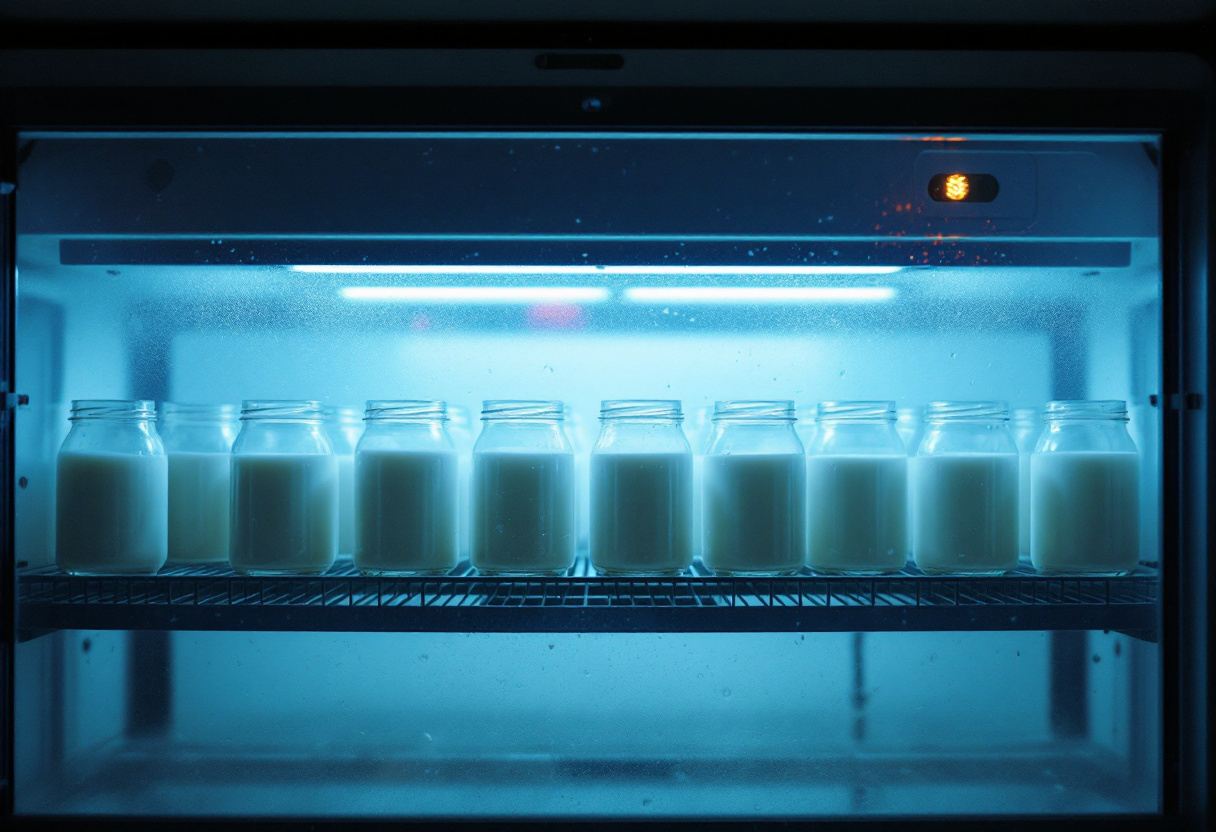
There is a room in every cosmetic laboratory that shoppers never think about. It contains ovens holding batches at elevated temperature, a refrigerator, sometimes a light cabinet, and rows of the product in the exact pack it will be sold in. What comes out of that room decides more about the product you buy than most of the marketing does.
Why stability testing exists at all
A cosmetic has to survive a journey nobody designs for. It may be made in spring and sold the following winter. It may sit in a lorry, a port, a warehouse without climate control, a shop window in July and a bathroom next to a shower. Over that period it has to remain safe, remain physically intact, and remain the product described on the label.
Under the UK cosmetics regime, the safety assessment that must exist for every product before it is placed on the market considers the stability of the product and its microbiological quality. The tests are therefore not optional extras. They are part of the evidence base behind the cosmetic product safety report that has to exist before anything is sold.
What is actually put through the test
The unit under test is the finished product in its final pack, not the bulk in a beaker. This matters because a great many failures are not failures of the formula at all. They are interactions between the formula and the container.
| Condition | Roughly what it simulates | What a failure looks like |
|---|---|---|
| Elevated temperature | Accelerated ageing, compressing months of shelf life into weeks | Separation, discolouration, odour change, viscosity loss, pH drift |
| Refrigerated and freeze thaw | Cold transport and storage, and repeated cycling | Crystallisation, permanent separation that does not recover on warming |
| Ambient real time | Ordinary shelf life, run alongside as the reference | Slow changes that the accelerated conditions did not predict |
| Light exposure | Display lighting and daylight through a window | Fading, darkening, degradation of light sensitive materials |
| Pack compatibility | The formula living against its own container for months | Swelling or softening of plastic, corroded metal, leaching, print or seal failure |
The real limits of accelerated testing
Accelerated ageing is a practical compromise, not a law of nature. Holding a product at raised temperature speeds up some chemical processes and not others, and it can produce failures that would never occur in real life as well as missing failures that would. That is why real time testing runs in parallel and why the accelerated result is treated as an early warning rather than a verdict.
This is worth knowing because it explains an industry behaviour that otherwise looks like cowardice. Formulators are frequently conservative with novel materials, not because they doubt the chemistry, but because they cannot yet know how the material behaves over three years in a pack, and the cost of finding out in the market is a recall.
It does not test efficacy. A product can pass every stability condition and do nothing at all for your skin. It does not test tolerability on a population, which is a separate exercise. It does not confirm that an active is still present in an effective form, unless a specific assay for that active has been included, which is an additional and optional piece of work.
A brand saying its product is stability tested is therefore stating that it did what every compliant product does. It is a floor, not a distinction.
Preservative efficacy testing, the other room
Separately from physical stability, most cosmetics containing water must resist microbial growth. The standard approach is a challenge test: the product is deliberately inoculated with specified organisms and sampled over a period to see whether the population falls at the required rate. A formula that fails is reformulated, not shipped.
The consequence for shoppers is direct. Preservative free is a claim that is either about a product with no water available for growth, such as an anhydrous oil or balm, or about a product using a preservation system the brand has decided not to call preservatives. There is more on that distinction in the piece on preservation.
Preservative free
That the product does not contain a substance listed in the preservatives annex to the cosmetics regulation, used for the purpose of preservation. That is a narrow and technical statement about a specific list.
It can be entirely accurate for anhydrous products, which contain no water for organisms to grow in, and for products preserved by other means such as low water activity or a very low pH.
It does not mean the product has nothing in it that inhibits microbial growth. Several materials with antimicrobial effect are listed on packs as solvents, humectants, fragrance components or skin conditioning agents, because that is the function the manufacturer has assigned them.
It does not mean the product is safer, gentler or less likely to irritate. Some non listed antimicrobial materials are used at levels far above where a listed preservative would be used.
The pack would have to explain how microbial safety is achieved instead. A product that is genuinely anhydrous can say so. A product relying on water activity, pH or packaging can say that too. What is not available is a product that contains water, sits in an open jar, and has no preservation strategy at all.
How the test room shapes the product you buy
Stability constraints are one of the main reasons products are less exciting than the science press suggests. A material may be well evidenced and still be unusable, because it goes brown in eight weeks, or because it eats the pump, or because it only stays active at a pH that makes the formula sting.
Three visible consequences follow from that room, and once you know them you see them everywhere.
- Opaque and airless packs. Where you see an aluminium tube, an opaque bottle or an airless pump instead of a clear jar, a stability decision is usually behind it.
- Lower active levels than the literature. The stable level and the studied level are frequently not the same, and the stable one wins.
- Formulas that changed quietly. A raw material discontinued or reformulated by its supplier forces a change that no brand wants to announce.
Testing as a barrier to entry
Stability, compatibility and preservative efficacy work costs money and takes months. That cost falls on every product, but it does not fall equally. A large brand amortises a test programme over a long production run. A small brand pays the same laboratory fees for a fraction of the volume.
The effect is that the safety regime, which exists for entirely good reasons, also functions as a wall around the market. This is a normal feature of regulated industries and it is rarely discussed openly by anyone on either side of the wall.
- Established manufacturers. Spread fixed testing costs across large volumes and hold in house capacity
- Testing laboratories. Sell a mandatory service into every launch in the sector
- Large brands. Face fewer credible small competitors than an unregulated market would produce
- Shoppers. Get products that are genuinely safer, and a narrower field of suppliers
Both effects are real at once. Naming the second is not an argument against the first.
What this is worth to you at the shelf
Very little as a purchase signal, and quite a lot as a corrective. Stability testing is universal, so hearing about it tells you nothing about a specific product. What it should change is your reading of two other things: it explains why the pack matters, and it explains why a product that has separated, changed colour or smells different is not a curiosity but a reason to stop using it.
If a product you have stored normally, within its period after opening, has visibly changed, that is a defect. It is worth reporting to the responsible person named on the pack, and if it is not resolved, to Trading Standards through the routes described by the Office for Product Safety and Standards.